Bracing for a Long Winter Election Season

With the Election Commission of India announcing the schedule for the upcoming legislative assembly elections in Rajasthan, Madhya Pradesh, Chhattisgarh, Telangana, and Mizoram, political parties are gearing up for the last major political battle before 2024. The elections are expected to be a test of popularity (or the lack of it) for the ruling Bharatiya Janata Party (BJP) and the Congress Party. While the results of the state elections have not been seen to impact the subsequent Lok Sabha elections in any significant way, the results will certainly power the campaign for the forthcoming Lok Sabha elections. 

   Significantly, in three of the five states going to polls, BJP and Congress are in a head-to-head battle. In Chhattisgarh, where incumbent Bhupesh Baghel seems to be popular with the electorate as per surveys, the Congress party is seeking to cash in on his government’s welfare record. From procuring paddy for farmers at the highest price in the country to paying an allowance to rural labourers, the Congress is going all out to showcase its achievements in the state. It has also brokered peace within the party, with Deputy CM T.S. Singhdeo standing solidly behind Baghel. On the other hand, the BJP has raised the issue of corruption and lack of industrialisation in the urban areas. It has an uphill task to increase its tally from 14 seats to 45 seats, which is the magic number to form the government.

   In Rajasthan, while BJP seems to be heading into the elections without its mascot Vasundhara Raje as its face, Congress has thrown its weight behind old warhorse Ashok Gehlot. While Ashok Gehlot is popular due to his government’s welfare measures such as the Chiranjeevi health insurance, smartphones for women, and employment guarantee in urban areas, there seems to be anti-incumbency against his MLAs. Other issues that will play a prominent role in the campaign include the restoration of the Old Pension Scheme and the Eastern Rajasthan Canal Project. A win will boost the Congress’ chances for a good show in the Lok Sabha polls whereas a defeat means BJP will be favoured to win all 25 Lok Sabha seats on stake for the third time in a row. 

   Except for 15 months when the Congress under Kamal Nath ruled the state, Madhya Pradesh has had a BJP government for the past two decades. Aware of anti-incumbency against his government, the BJP has sought to downplay Shivraj Singh Chouhan’s role in the campaign and has fielded senior leaders and MPs as a counter to him. The central leadership of the party has taken control of the campaign, although the road ahead is bumpy. 

   On the other hand, the Congress is making a spirited bid to come back to power in this crucial heartland state which was once its bastion. With Nath at the helm, the party has been raising multiple issues including unemployment, corruption, and farmers’ distress, among others. He has been extensively touring constituencies that his party has lost in the last two decades, troubleshooting feuds between bickering party workers and hoping the rivalries do not dash his chances of winning the state.

   Telangana is set to witness an interesting triangular battle between the ruling Bharat Rashtra Samiti (BRS) of K. Chandrashekar Rao, the BJP, and the Congress. BRS hopes to retain power under KCR who has launched several innovative welfare schemes. Rejuvenated by Rahul Gandhi’s Bharat Jodo Yatra, Congress hopes to encash the anti-incumbency against KCR, although it faces a formidable task. The Lok Sabha performance (4 seats) gives the BJP hope that it can evolve from being a marginal player in the state. Its aggressive campaign, based on allegations against KCR’s daughter of playing a role in the Delhi liquor “scam”, aims at garnering a significant number of seats to develop a foothold in another Southern state.   

   Mizoram, formerly a Congress bastion, will largely witness a bipolar contest between the ruling Mizo National Front (MNF) and main challenger Zoram People’s Movement (ZPM), even as BJP tries to gain a foothold in the state in which it bagged one seat in the last elections. The Congress which ruled the state for a long time, is struggling to revive its fortunes even after a leadership change. The ongoing strife in neighbouring Manipur is set to play a big role in the campaign in the days to come. According to reports, both the ZPM and the Congress are hoping that political polarisation on ethnic lines following violence in Manipur may boost their chances.

   For the Congress, which won Rajasthan, Madhya Pradesh, and Chhattisgarh in 2018, it is important to win these states again. With Mallikarjun Kharge at the helm and a host of issues, including the newfound issue of caste census, Congress has a lot going for it. The BJP will rely on Prime Minister Narendra Modi’s image and the central government’s performance and promises. This strategy has not always yielded dividends, as in Karnataka earlier this year. 

   It has leadership and organisational problems at the state level, with Vasundhara Raje Scindia in Rajasthan and Shivraj Singh Chauhan in Madhya Pradesh. The party is also likely to draw attention to the Centre’s and PM’s successes and policies — G20, women’s reservation Bill, increased subsidies on LPG cylinders, etc. The elections will also be the first litmus test for the opposition grouping INDIA, although only one constituent, Congress is in the fray.
Decoding the ‘Bebinca’: Queen of Goan Desserts

If there’s one dessert that has gone places from the tiny state of Goa, it is none other than the Bebinca. Known by various spellings , this Portuguese-influenced dessert is the most popular delicacy in the state. It makes appearances at every occasion, be it a wedding, Christmas, birthday party or feast. This has earned Bebinca the sobriquet of ‘Queen of Goan Desserts’.

However, its origin is shrouded in mystery. Some claim that much like other confectionaries of the religious convent, Bebinca was also invented by Portuguese nuns in the 17th century.

Contrary to most baked foods that use egg whites, here the yolks take prominence. Using egg whites to starch clothes was a common practice of the religious Nuns which is still prevalent in parts of Goa. As a result of this, most people, much like the Portuguese nuns of Santa Monica Convent in Old Goa, would end up with an excess of leftover egg yolks. Legend has it that Bebinca came to be a solution to leftover yolks.

These stories find a mention in historian Fatima da Silva Gracias’ book, Cozinha de Goa: History and Tradition of Goan Food, where she writes that one of these nuns from Santa Monica Convent was called Bebiana. She invented a seven-layered pudding using leftover yolks to represent the seven hills of the old city of Goa and Lisbon. This pudding was then sent to the priests, possibly those living in the Convent of St Augustine—the Order to which Santa Monica belonged—who although impressed, pointed out that seven layers weren’t enough for them. They advised Bebiana to increase the dessert’s size to accommodate at least a dozen layers. Today, this pudding is known as Bebinca in her honour and boasts from 8 to as many as 16 layers.

The Queen of Goan Desserts has traveled from India to Sri Lanka, and from Macau to Brazil!. Next time your in Goa, don’t forget to taste this delicacy.

The Health Benefits of Sports

Continuous physical activity is a must, in order to keep oneself healthy and fit. Playing Sports can have many beneficial long term advantages such as promoting an active lifestyle and boosting self- confidence, especially for the youth.

Here are some benefits of taking part in Sports activities:

 1) Improves your sleep: Exercising yourself in the form of Sporting activity helps you to get good sleep. Sports help in both the quantity and quality of your sleep. While a lot of research has been conducted on the effect of sports on sleep, studies have indeed found that sporting activity can induce good sleep.

2) Good Stress- buster: Stress is an inextricable part of life. And Sports help in the release of stress. Sports cause one’s boy to release a chemical called endorphin, which relieves pain and stress. In fact, a few studies have shown that at least 20- 30 minutes of Sports each day can help people feel relaxed and calm. Clearly, Sports is the best way to let go of stress.

3) Lowers Blood Pressure: The heart is one of the most important organs of the body. How can one keep the heart strong? Well, regular Sports activity can help make one’s heart stronger. And a strong heart can pump more blood without stressing on the cardiovascular system. As a result, the blood pressure is reduced and one’s overall health is stable.

4) Leads to effective Immune system: Taking part in Sporting helps in improving the health of the immune system. It helps in weeding out the bacteria and other invisible germs from the lungs and passages of one’s system. Sports have also shown to play a key role in the metabolic health of people. In conclusion, sports can improve one’s immune system to a great extent.

5) Helps control Weight: Playing sports on a regular basis can help prevent weight gain and promote one’s weight loss. Apart from losing weight, physical movements associated with Sports can increase the calories the body uses. Clearly, Sports is one of the best ways to maintain one’s weight in the long term.  

5 Tips to Stay Safe and Healthy in Summer

Summer is here. And so are some important instructions, to ensure one doesn’t go overboard in this humid weather.

   Here are some tips that you can keep in mind to stay healthy and fit this summer:

1) Eat Light meals: In Summer, eating healthy meals that are light is considered the best option. It will lower the amount of heat in your body, as well as keep you in good shape. If possible, try eating vegetables and fruits which contain high water content such as watermelons, oranges, tomatoes etc. Avoid heavy food items like Pizzas, Meats and Burgers, as these will only generate more heat in your body.

2) Drink Water regularly: Keep yourself well hydrated in summer by consuming at least 2 to 3 litres of water on a daily basis. Preferably, every 45 minutes, do take a sip of water. While going outdoors, make sure that you carry a small bottle of drinking water, so that you don’t feel thirsty.  

3) Avoid Alcohol and restrict beverages: Alcoholic drinks completely dehydrate you. So, make sure to avoid alcohol during the summer months, especially in April and May. Consume alcohol only if it’s absolutely necessary. Also, restrict yourself from having beverages such as Sugarcane juice and mango juice that contain excessive sugar, as these tend to make you dehydrated.

4) Exercise daily: Though exercising in summer is not a good option, yet one can consider it cautiously. Exercise daily, but make sure to take precautions. When you do exercises in the heat, go step by step, without stressing yourself. In case you feel tired, take a short break, before restarting again. But, don’t overdo. Also, conduct your exercise in a shady place, preferably early in the morning.

5) Protect your Skin: If you’re a person who is outdoors for most of the day, then you need to take good care of your skin. Apply a good sunscreen before leaving the house. However, just because you have put sunscreen, do not take your skin health lightly. You still need to protect yourself from the rays of the sun. Avoid roaming around unnecessarily in sunny areas, as it will darken your skin and make you look ugly in the short term.     

The Clampdown of Dissent in India

The past several months have been very difficult and arduous times for India. Journalists, students, citizenry, activists, filmmakers, and anyone critical of the Indian government and its handling of different situations (Covid, for example) has been arrested and put behind bars in an unfashionable manner. While convictions are at an all-time low, the administration doesn’t shy away from filling up the country’s jails, just to portray itself tough on law and order. India is going through a phase where dissent is being side-stepped and brushed under the carpet. The media, opposition, and judiciary, have been under tremendous pressure from all quarters of society to act.

Before going into further details, do consider the following two examples;

* On the night of February 13 this year, Disha Ravi, a young 22-year-old Climate Rights Activist was picked up from her house in a Bangalore locality by the Delhi Police and sent to custody in the National Capital. It was alleged by authorities that she was part of a larger ‘toolkit’ conspiracy related to the farmers’ protests which were ongoing at that time (and still goes on) in the country. It was also alleged by the Delhi Police that she was networking with individuals linked to the radical Khalistani movement abroad.  It was only on the 24th of February that she was granted bail by a Delhi Court. This case drew International attention.

* Siddique Kappan, a journalist was traveling by train to Uttar Pradesh to cover the horrific Hathras gang-rape incident in the state. The state police suddenly arrested him on charges of sedition. and other frivolous charges, after he got out of the train. To this day, he has been lodged in a Mathura Jail and there’s no sign of him being released soon. While in jail, he even tested positive for Coronavirus. It is also being alleged by the administration that Kappan is linked to a radical outfit called the ‘Popular Front of India’.

   For a nation like India, also the world’s largest democracy in the world, the crushing of dissent is a major blot on Free Speech and expression. After all, India’s Constitution guarantees its citizens the right to freedom of speech and expression. Article 19 says “all citizens shall have the right to freedom of speech and expression. Of course, there are reasonable restrictions that are placed on this right. One doesn’t deny the same.

  However, the freedom to have one’s own opinion and criticize are essential and crucial pivots for any functioning democracy in the world. Dissent is a crucial hallmark of a democratic nation. In India, crushing dissent has become a norm, so to say. “We have also become used to the idea that the Indian State has the absolute right to crush dissent no matter how brutally this is done. We know now that the Dalit teenager from Hathras was gang-raped by the four men she named before dying. Charges have been brought against them. But, since her battered, broken body was burned in the dead of night without funeral rites, Yogi Adityanath’s officials were able (with the help of the media) to perpetuate for the longest time the lie that she was killed by her brother in an ‘honor killing. Those who dissented were charged with being part of an international conspiracy of ‘leftists and liberals’ to defame India’s fair name” writes the prominent writer Tavleen Singh in an article in the Indian Express on January 3, 2021.

   In the Union Territory of Jammu and Kashmir, which was stripped of its Special Status (also called Article 370) on August 5, 2019, the situation is no better. Using purely draconian constitutional provisions like the Unlawful Activities and Prevention Act and Public Safety Act, the administration has wrongly put myriad people behind bars for no fault of theirs. Many of the people who have been picked up are alleged to have been involved in terrorist activities in the most militarized conflict zone of the world. Banning Dissent has become the new normal for the average Kashmiri. The administration has gone so far as to form a task force to purge the government of ‘dissenting’ employees.

   Social media is another aspect when it comes to the clampdown of dissent in the country. In the disputed region of Jammu and Kashmir, the use of social media has been an effective weapon of mobilization of people towards important issues in the union territory. However, the administration has used repressive tactics to counter the so-called ‘anti-national’ messages on social media. The union territory has faced multiple internet shutdowns which have been called out by International Organizations like the United Nations and Amnesty International. These actions have been seen as the stifling of dissent by many observers. What’s frustrating is that many social media platforms like Facebook, Twitter, and Instagram have been accused of towing the government’s line when it comes to suspending the accounts of users.

   The clampdown on Dissent has also brought the country under tremendous International Focus for the first time in decades (the last being during an Emergency). In an address to the Human Rights Council on the 27th of February this year, its Commissioner Michele Bachelet raised the issue of sedition, arrest of journalists among other things. In the context of the ongoing Farmers’ protests, Bachelet noted that sedition charges on journalists and activists for reporting or commenting on protests and attempts to curb freedom of expression on social media “are disturbing departures from essential human rights principles”. The clampdown on Dissent has raised many more troubling questions than answers. The BJP led government’s response has been found wanting. As we have seen from the cases of Disha Ravi and Siddique Kappan, the government has turned the act of dissent into a criminal offense itself. No doubt then, that the prestigious V- Dem Institute of Sweden this year has classified India as an “electoral autocracy’, a reminder of the government’s crackdown on civil liberties, dissent included. Similarly, Freedom House, a think tank based in Washington, downgraded India from ‘free’ to ‘partly free’, an indirect indication that the crackdown on free speech is affecting India’s democratic values. The government of India, in its usual ways, dismissed these reports as incorrect, misleading, and whatnot.
   Ironically, India which targets Pakistan and China for the human rights of Minorities and Uyghurs finds itself in the same situation when it comes to basic rights like Article 19, which permits free speech. The government has to introspect on why India is in such a deep mess when it comes to Free Speech. The culture of intimidation has to go away if India has to progress into a model for other nations.
   In conclusion, the survival of democracy is based on the basic rights of free speech and the right to criticize/ dissent. By disrupting these basic rights, there is a question mark on India’s future. The citizenry cannot live under a cloak of fear and repression of the state. People have to have a right to express their approval or disapproval of the state’s actions. Their views help to strengthen public formulation. One only hopes that India comes out of this atmosphere of repression, sooner rather than later.

Remembering Sunderlal Bahuguna

As the world braces to reduce carbon net emissions, the issue of deforestation comes to mind. And one man who was synonymous with deforestation in India was the late Sunderlal Bahuguna.
   Bahuguna, who was known as the Architect of the Chipko Movement, passed away last week. He taught communities to hug trees, in order to protect them. He gave the slogan of ‘Ecology is Permanent Economy’. The Chipko Movement brought the world’s attention to the burning issue of deforestation. An important aspect of the Movement was the inclusion of women. Women in the Himalayas embraced trees and ties Rakhis to them.
   When the Tehri Dam project was proposed, Bahuguna was staunchly against it. He sat on fasts, often stretching upto many weeks. In fact, he even shaved his head, before going to protest at the site of the Tehri Dam.
   A man of true Gandhian Principles, Bahuguna lived in a small ashram and believed in Non- Violence. He was a vanguard of sustainable livelihood. He also spoke about the need to use wind energy and solar power. He lived his life in true simplicity and did not believe in ostentatious living.
   Sunderlal Bahuguna will forever be remembered as the man who protected India’s forests and he shall be a model for future generations to emulate. Bahuguna’s demise is a huge blow to the environmental community, not just in India, but across the globe.

Interview: Steve Clemons on the Quad Summit 2021

On March 12th, Leaders of the “Quad”- Australia-India-Japan-United States met in a virtual summit. In the context of this summit, I conducted an email interview with Steve Clemons. Steve Clemons is Editor-at-Large for The Hill. He is an MSNBC Contributor and comments frequently on politics, economics, and foreign affairs on national television and radio outlets. Besides, he has also been a part of the World Economic Forum’s Annual Davos meeting. Clemons is also publisher of the widely-read political blog, The Washington Note.

Edited excerpts from the interview:

1) What are the major takeaways of the recent Quad Summit?

The key takeaways are that the President of the United States, Joe Biden, is putting emphasis on multilateral discussions with other leaders about regional stability and democracy promotion in the Indo-Pacific.  This is a change in tone and style from the last President.  While China was not explicitly mentioned, the reason for the meeting is to demonstrate that core nations in the Indo-Pacific are talking and are concerned about regional stability and oppose any country, read China, from disrupting the status quo.  This was an optics meeting, but an important one.

2) What does the Quad Summit signify for US engagement in the Indo- Pacific region?

Both the Quad Summit of four key regional heads of government followed by a trip by Secretary of State Blinken and Secretary of Defense Austin to Japan and Korea — as well as a key national security meeting with Chinese leaders in Alaska — demonstrate that the U.S. is reengaging in the security and economic contours of the Indo-Pacific.  This is a demonstration of American attention and engagement, where before the previous White House often communicated disinterest and even the notion that regional security was not a concern of the U.S.  The Quad Summit is an inflection point for US attention in the region and a turning point for dialogue between anchor stakeholders in the Indo-Pacific concerned about Chinese domestic behavior and aggression regionally.

3) What is your opinion on the declared cooperation of the Quad Countries for providing vaccines against Covid- 19?

I think it is a step forward, but there is still a lurking vaccine nationalism today that is preventing the broader and fairer distribution of vaccines globally, particularly lesser developed countries.  But the statement is a contribution to getting vaccines to developing countries.  It should be noted that it is recognized in the US and globally how vital India has been in the R&D and clinical trial dimensions of Covid-19 vaccine development.

4) Could you give me a broad-brush picture of the Biden administration’s approach towards India?

Really not my area of expertise — but my sense from afar is that the administration wants to promote quality economic and security engagement with India.  They want to find a way for India to be a more constructive partner on climate change remediation strategies — and there is a sense that India has not been a partner in that process.  They want to see responsible nuclear energy development that remains for non-military purposes.  I think the Biden team sees India as a vital rising global economy and population center — but that it flirts with theocratic scaffolding regarding its national policies, and that is disconcerting to the Biden team. I think you will see serious engagement, but also some ‘tough love’ at moments from Biden to Modi regarding the character of India’s democracy.

5) After difficulties on the immigration issues, do you predict a restoration of immigration, student and gig visas for Indians due to the new Bill and other reforms?

Eventually I do see restoration of student and J- and H1B visas for Indian citizens, in parts because of the demands from US universities and US high tech and biotech firms who need the expertise from Indian PhDs, innovators, and others.  I don’t think that this will happen immediately – but the tech community has put restoration of ‘talent flow’ into US universities and firms at a very high spot on its priority list.  I think that will have impact.  The Biden team will build up and restore across the board immigration reform that brings more people from abroad into the U.S., in contrast to the Trump administration working to strangle this flow to very low levels.

6) Could you tell me about the other emerging areas of Indo-US cooperation?

I think that there is growing contact and discussion on military to military concerns – and then discussion with India on a wide variety of other transnational issues.  These include climate, trade, migration, and more.  But one of the areas I hear a lot about from folks like former State Department official R. Nicholas Burns, former Secretary of State Madeleine Albright, and others is now the trust-building in US-India nuclear energy cooperation can become a foundation for broader trust-building between the two countries.  This sounds a bit too narrow to me given the scale and size of India’s footprint in the world, but this is on of the topics that pops up a lot in Washington.

The History of the ‘Andolan’

On Monday, while replying to the motion of thanks to the President’s address, Prime Minister Narendra Modi used a term ‘Andolan Jeevi’. His term came in response to the farmers protesting the three farm laws. Terming the “new breed” of agitators “andolan jeevi”, he hit out at those who were fuelling it and said the nation should guard against them.

But apart from the remarks, comments and buzz on social media about ‘Andolan Jeevi’, the fact is Indian Democracy has survived and thrived on movements or ‘Andolans’. Here are 2 prominent ones:

1857 Uprising: Regarded as India’s First War of Independence, the Revolt of 1857 which began at Meerut on 10th May that year, was a prolonged period of uprising against the British domination of the Indian Subcontinent. It was one of the first organised protests. Though it initially began as a revolt of the sepoys of the British East India Company, it spread to the common masses. This unprecedented event in India’s history later sowed the seeds of India’s Independence movement.

Navnirman Andolan: Initially begun as a movement against corruption in Gujarat in 1974, the Andolan was led by students across the state. The spark was lit in December, 1973, when students of L.D. College of Engineering, Ahmedabad protested against a hike of hostel fees. Later, a similar type of protest erupted in Gujarat University which led to clashes. Protests spread across the whole of Gujarat in the days ahead. The Andolan eventually led to the resignation of then Chief Minister Chimanbhai Patel. The Andolan was representative of the people’s power to change the government.

Protests have been an integral part of India’s history and will always be.  

BOOK REVIEW: INDIA’S ISRAEL POLICY

India’s foreign policy toward Israel is a vast subject. Throughout the twentieth century many arguments have come up over the Palestinian problem and also the future of bilateral relations. However, no text comprehensively looks at the attitudes and policies of the Indian state towards Israel, especially their development in conjunction with history.

Kumaraswamy is the first person to account for India’s Israel policy, revealing surprising inconsistencies in the positions taken by the country’s leaders, such as Mahatma Gandhi and Jawaharlal Nehru among others, and even tracing the crackling tensions between its professed values and realpolitik. Kumaraswamy’s findings junk the belief that India possesses a homogenous policy toward the Middle Eastern countries. In fact, since the early days of independence, many within India, including political leaders have supported and pursued good relations with Israel.

Using the material and evidence derived from archives in both India and Israel, Kumaraswamy investigates the factors that have hindered relations between these two countries despite their numerous commonalities. He also considers how India destabilized relations, the actions that were necessary for normalization to occur, and the directions bilateral relations may take in the future. In his most controversial argument, Kumaraswamy underscores the disproportionate affect of anticolonial sentiments and the Muslim minority on shaping Indian policy.  

After the bomb: The changing face of the world order 75 years on

World War II finally ended, in Asia, 75 years ago this month. After the death and destruction of two world wars in the first half of the 20th century, it was hoped a third might be avoided.

This analysis briefly examines three points, each with its origins in WWII, as a measure of a changing world order: gridlock in the UN; evolving great power competition; and nuclear weapons proliferation.

The institutional foundations put in place to prevent such a calamity from reoccurring are being choked and eroded by great power rivalries. The horrific final strategic act of the war – the use of nuclear weapons – continues to cast a mushroom cloud shadow over the future.

Today, the resulting strategic situation is, arguably, more dangerous than at any time since 1945. The international order is changing and, just as in August 1945, Asia is at the centre.

The institutional pillars that support the world order as we know it today are a construct of the final years of World War II. Ostensibly as a mechanism for looking after humanity and arbitrating international disputes from trade to international security, their purpose was to avoid another world war.

The foremost of these is the United Nations (UN). Other institutions set up to facilitate a more peaceful world after 1945 include the World Bank and the International Monetary Fund.

The most important appendage of the UN is the United Nations Security Council (UNSC). The former Allies – the United States, United Kingdom, France, Russia and China – hold sway as the permanent five (P5) members. Each has, and willingly uses, veto powers over any resolution before the council.

Today, the UNSC is largely paralysed. Competition and disagreement between the permanent members are severely compromising its efficacy. Russia and China have frequently played their veto cards, most recently over Syria, to vex the US.

In a further challenge to the post-1945 institutions, other multilateral fora have been established by Russia and China that exclude other P5 members.

The Shanghai Cooperation Organisation was founded in 2001. A Eurasian institution spearheaded by Moscow and Beijing, its official languages are Russian and Chinese.

China’s growing confidence on the international stage has led the development of a new group of competing institutions and arrangements such as its Belt and Road Initiative, and the Asia Infrastructure Investment Bank (AIIB). President Xi proclaimed the AIIB represented a new multilateralism. And yet, as tensions mount between them, the US is not a member.

And just as the United States has imposed tariffs and sanctions against China and Russia, it’s little surprise that they’ve pushed back with veto activity in the UNSC.

A further sign is the degree to which the World Health Organisation (WHO) has become a geopolitical pawn since the emergence of COVID-19. President Trump is adamant the United States will now withdraw from the UN body over what he claims to be Chinese interference. Needless to say, this hasn’t helped relations with Beijing.

Trump’s erratic behaviour fuels speculation that the US is stepping away from its willingness to lead the world through times of trouble, as it has done for the past seven decades.

If this is true, it’s another signal that the post-1945 order may be changing more rapidly than many people might think.

Behind the moves to recast the contemporary world order is a complex web of great power rivalries. Principally, these are between the US, China and Russia, but also, to a lesser degree, India. It’s the US-China feud that’s the most acute, but the situation is complicated because there are other states demanding a seat at the big table.

For some time, Russia has been agitating to regain its place as a great power – as its calculated moves against Georgia, Ukraine and, most recently, in Syria reveal. This comes as no surpise. Its resurgence was presaged by a statement made by Vladimir Putin in 2005, nostalgic to restore Russia to its former Soviet might. Since then, Russia has consistently acted out of self-interest on the world stage to position itself as a great power.

However, it’s the rise of China that has signalled the greatest fundamental shift in the post-1945 order – certainly since the collapse of the Soviet bloc that ended the Cold War.

Arguably, China represents a far more potent challenger to the US than the Soviet Union did. More recently, with the arrival of President Xi Xinping in 2013, China has taken a more assertive foreign policy line, as evidenced in its territorial claims in the South China Sea.

China and India, as we’ve recently seen, remain locked in tensions that have their origins in their own 1962 war. These issues continue to simmer as both seek to reaffirm their international reputations as world powers.

They continue to regard each other warily, with India developing its strategic capabilities to deny Chinese meddling in Delhi’s sphere of influence. India’s development of relations with the US since 2005 is further evidence that the allegiances and alignments of world power are shifting.

The 21st century is evolving as a strategically dangerous one, with Asia as the focal point. It’s the region where great power aspirations are colliding with the norms of a global order forged in the devastation of two world wars in a different century.

With this shift, the primacy of the still-formidable power of the US is no longer a given. The security umbrella it’s long provided its allies is being questioned across the world. America’s unipolar moment has passed, and the relative power gap between it and its competitors is closing.

Then there’s the special case of North Korea. By none of the typical measures is the “Hermit Kingdom” a great power, but it is unambiguously a nuclear weapon state. This gives it a chilling currency, a fact clearly revealed during its 2017 missile testing, and its willingness to engage in a serious game of nuclear brinkmanship with the US. Its unpredictability makes it a unique threat to the calculus of international relations.

As a result of this international competition, the 21st century is evolving as a strategically dangerous one, with Asia as the focal point. It’s the region where great power aspirations are colliding with the norms of a global order forged in the devastation of two world wars in a different century.

All of these power complexes reverberate against and through each other. In the Cold War, the great power rivalry was bipolar; today, power competition is multipolar. With more states pursuing their own agendas, it will be far more difficult for any one state to exert a controlling influence.

The crucial determinant in this global balance of power equation is the dynamic between Washington and Beijing. How this plays out will shape the other power relationships. The winner of the US election on November 3, Trump or Biden, will have a significant impact on how the next phase of this rivalry unfolds.

Ominously, the most existentially dangerous element inherent in the 21st century world order, one that has its origins in the late 1930s and has since been a great power staple, is the proliferation of nuclear weapons.

In recent decades, it’s been Asian states that have been racing to develop their nuclear weapons capabilities. China, India, Pakistan, North Korea and Israel all have their bombs. Iran and possibly Saudi Arabia want one, too.

This highlights the urgency of the situation. It should not be forgotten that the US and Russia are also players in Asia’s game of nuclear chess. All of these states are modernising their nuclear capabilities, and they appear to have no interest in discussing, much less developing, any sort of arms control framework.

Two principal factors are driving this. One is national security and the perceived need of a nuclear deterrent to ward off potential, or more powerful, aggressors. A second is prestige – the notion that developing a nuclear weapons capability signals a mastery of complex engineering, thus placing less powerful states on a more equal footing with the great powers.

Pakistan and North Korea, in particular, fit these criteria, just as India did in 1964 when it undertook to develop its own bomb in response to China’s first nuclear test.

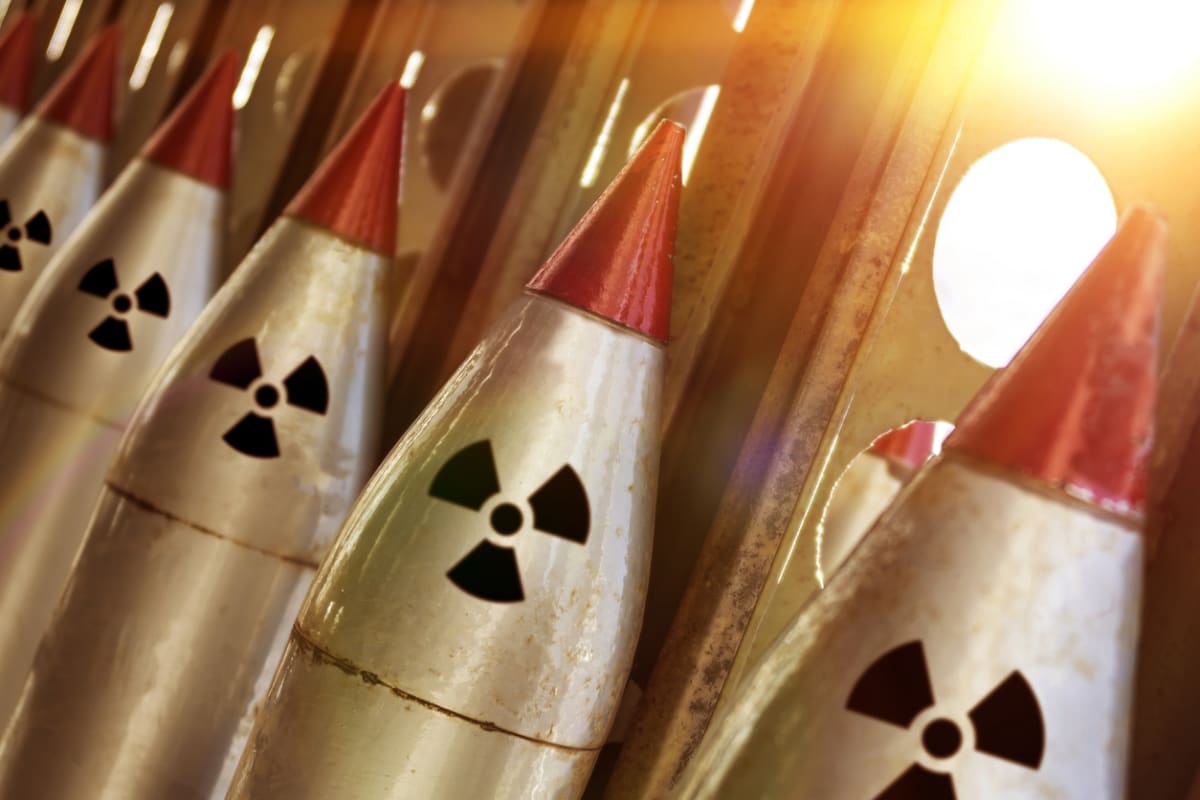
Close-up picture of nuclear missiles

Disturbingly, a recent publication by the Stockholm International Peace Research Institute warns that the nuclear weapons situation is only going to deteriorate. This is supported by the 2020 Federation of Atomic Scientists analysis that argues that the world “Doomsday Clock” is at a mere 100 seconds to midnight.

As the bomb is remembered for its macabre 75th birthday, it’s all the more important to seriously think about not only the human consequences, but the political and military implications, of the Hiroshima and Nagasaki bombings in August 1945.

History shows that world orders have expiry dates. The post-1945 world order, ushered in 75 years ago this month, is in its late autumn. Its institutions are stagnating and struggling to maintain relevance as attempts to replace them are afoot. Great power rivalries are intensifying as the number of nuclear weapons states slowly grows, all of them striving to improve their strategic capabilities.

These are but a few signals of the many complicated drivers indicating that shifts are well underway to a new world order.

The passing world order was born under a mushroom cloud. By examining the lessons of the past and not becoming complacent, it just might be possible that the new one will have a more peaceful emergence.

This article was first published on Monash Lens. Read the original article